Personal mental health and wellness tool kit

Evidence-based tools and strategies to help manage stress during emergencies and disasters

Wild columbine. Black-ink illustration generated by AI

The Trauma & Recovery Research Unit at McMaster University developed this tool kit as part of our work on Healthcare Salute: Thank You for Your Service, a project that studies how the COVID-19 pandemic affected Canada’s health care workers and their loved ones.

✳️ Learn more: healthcaresalute-soinsdesantesalute.com

The evidence-based tools and strategies presented here are meant to help you and your family members manage stress during emergencies and disasters.

Try these various approaches to find the tools and strategies that work best for you.

Remember that in order to help others, you need to put your own oxygen mask on first.

The more you practice these strategies, the stronger your muscle memory will become to use them during times of stress and trauma.

During calm times, as well as during stressful and traumatic times, practice these strategies to better support your mental health and well-being before, during, and after emergencies and disasters.


  • 5-4-3-2-1 grounding

    Use the 5-4-3-2-1 grounding technique to mindfully take in the details of your surroundings using each of your senses.

    Notice:

    • Five things you see.
    • Four things you hear.
    • Three things you feel.
    • Two things you smell.
    • One thing you taste.

    Try to notice small details that your mind would usually tune out, such as distant sounds or the texture of an ordinary object.

    ✳️ Learn more from Healthcare Salute


    🔈 Press play to listen to this content.
  • Accept things as they are

    It is challenging to acknowledge when a situation is hard, especially when you think it should be different. Here are some steps to help you accept things as they are and recognize when you are struggling to do this:

    1. Notice when you are trying to change or deny things that can’t be changed. This may lead to thoughts of despair or unfairness, or to feeling emotions such as anger and frustration.
    2. Remind yourself that “It is what it is,” and nothing can be done now. You may need to do this multiple times a day/hour/minute, depending on the situation and your mental state.
    3. While acknowledgment is important, so is allowing yourself to feel the emotions that come along with it, such as sadness and disappointment. These feelings are healthy.

    🔈 Press play to listen to this content.
  • Avoid information overload

    Wanting to stay updated with current and notable events is expected. However, too much information can lead to you feeling negative, overwhelmed, and overstimulated.

    You can avoid some of these feelings by reducing the time and instances you check news and information sources to once or twice a day. Along with this, seeking out credible sources of information can also help you avoid misinformation and frustration.

    It is also a good idea to totally unplug and not look at your devices at least once a day, even briefly.


    🔈 Press play to listen to this content.
  • Body scan

    The body scan is one of the most effective ways to begin a mindfulness meditation practice. The purpose is to tune in to your body — i.e., to reconnect to your physical self — and notice any sensations you’re feeling without judgment.

    • Sit quietly or lie down
    • Start at one end of your body and focus on each body part
    • Notice any areas of tension and then try to soften or relax them
    • Continue until you have mindfully scanned each part of your body

    ✳️ Learn more from Healthcare Salute


    🔈 Press play to listen to this content.
  • Boxed breathing

    Boxed breathing, also known as four-square breathing, involves:

    • Inhaling for a count of four
    • Holding air in your lungs for a count of four
    • Exhaling for a count of four
    • Holding your lungs empty for a count of four before beginning anew

    It can help to visualize your breath travelling around the four edges of a square while breathing.

    ✳️ Learn more from Healthcare Salute


    🔈 Press play to listen to this content.
  • Cold splash

    Splashing cold water on your face from, say, a sink or a bowl has two main effects:

    1. Providing a controlled shock to your system, which helps shift your focus from what is distressing you.
    2. The cold water will help reduce your heart rate, making you feel calmer and less anxious.

    🔈 Press play to listen to this content.
  • Cope in the moment

    If you are at work and experiencing stress or overwhelming emotions, it can be difficult to cope with them in the moment. Here are some strategies you can implement when at work:

    • Actively listen to what your colleague is saying to keep you in the present.
    • Clasp your hands tightly to use the sense of touch to ground yourself.
    • Affirm: Remind yourself you can do this. Recall successful results in the past.
    • Scan your environment and note key characteristics. Use your sense of touch to ground yourself.
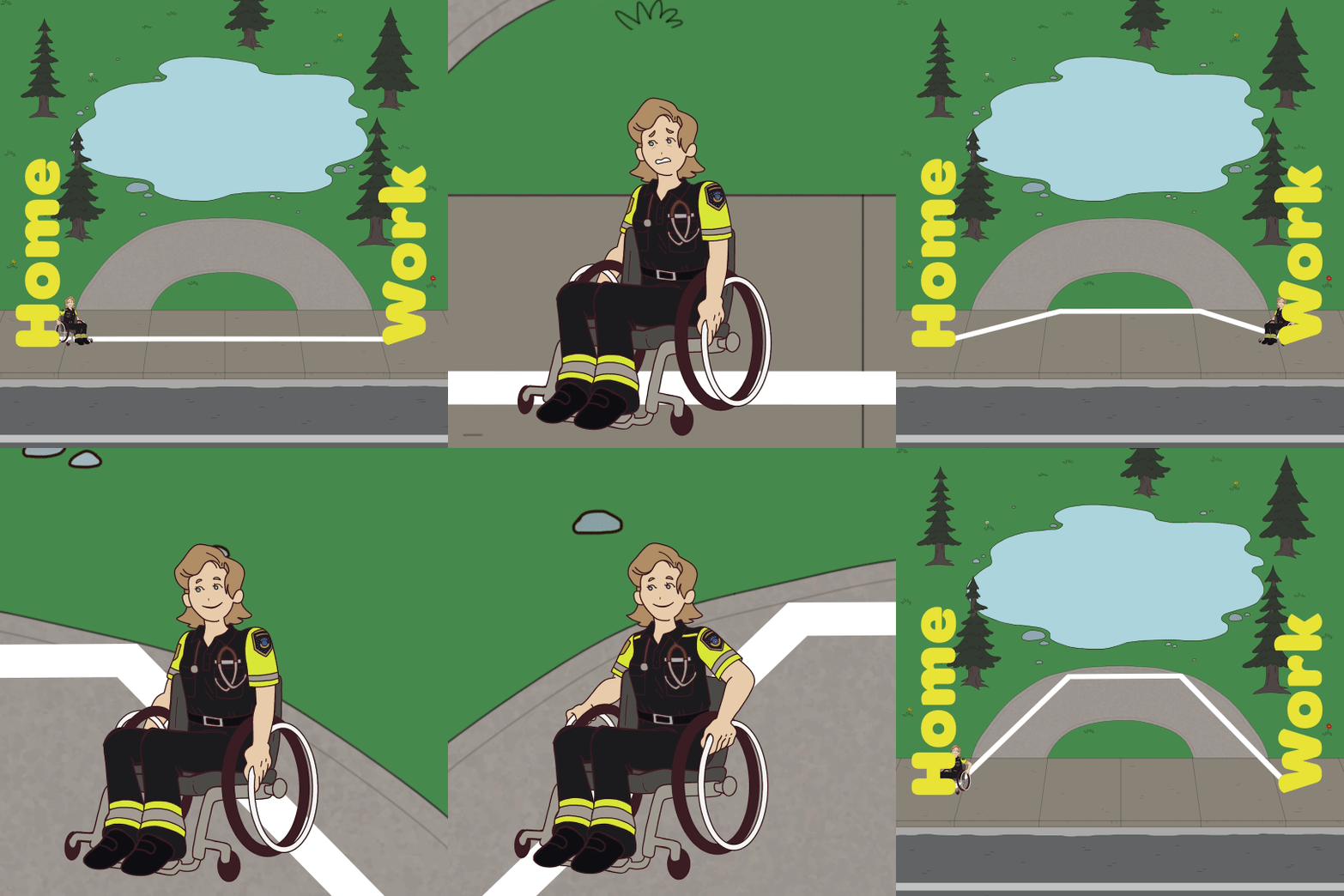
    • Walk slowly: Take notice of each step as you walk from one area to the next to help yourself reduce intense emotions.

    🔈 Press play to listen to this content.
  • Establish transition routines

    To help yourself transition from work mode to home mode:

    • Create a routine or decompression time. Allow time for rejuvenation to recover from the emotional or physical exhaustion you may be feeling.
    • Listen to something that uplifts or relaxes you on the way home to help take your mind out of work.
    • Have a signal with your spouse or family member that indicates you need time before interacting with them. For example, thumbs down as you enter lets them know you had a difficult day and need a hug.
    • When you get home, take the dog — or just yourself — out for a walk.
    • Use meditative, grounding, or gratitude practices prior to reintegrating with your family.

    🔈 Press play to listen to this content.
  • G.I.V.E. C.A.R.E.

    At times, you can be your own worst critic. When you find yourself questioning your ability to bounce back, know that you can do something different, and it is okay if you make mistakes as you learn.

    Let’s get to a place where you’re going to:

    1. Learn something new.
    2. Practice it.
    3. Give yourself credit.

    Don’t forget to G.I.V.E. C.A.R.E. along the way:

    • G → Be gentle with yourself.
    • I → Take interest in why you might be feeling this way and whether you might be missing something that might change how you’re feeling.
    • V → Validate, recognize, and acknowledge your suffering. Be fair to yourself in understanding that you are not alone, and that suffering is part of being human.
    • E → Address yourself in an easy manner. Be kind, gentle, and fair with yourself, even if you’re unable to do things as you’d like right now.
    • C → Be curious about your options. What could really help you in this moment?
    • A → Acknowledge that change is hard and doing things differently is difficult.
    • R → Reflect on which of your options is most likely to help you get to where you want to be.
    • E → Encourage yourself to go through with the option that you’ve decided is best, even and especially when it’s hard.

    🔈 Press play to listen to this content.
  • Grounding stones

    You can self-soothe stress and anxiety using grounding stones. These smooth, coloured stones have historically been used as a means of stress relief and relaxation.

    • Place the stone between your index finger and thumb.
    • Gently move your thumb back and forth across the curve of the stone.
    • Pay attention to why you picked up the stone.
    • Accompany your steady breathing with positive thoughts and emotions.

    🔈 Press play to listen to this content.
  • Half smile, willing hands

    Stress can often lead to impacts on our bodies, but the reverse is also true: our bodies can have profound impacts on our minds.

    To help your body communicate to your brain that you are okay, practice the half smile, willing hands strategies. These strategies can help us regulate our systems and feel better in the moment.

    Half smile

    1. Relax the muscles in your face, starting with your forehead and moving down to your chin.
    2. Turn up the corner of your mouth very slightly to create a “half smile” reminiscent of the Mona Lisa’s.

    Willing hands

    1. Either sit comfortably, stand, or lie down for this exercise based on your preference.
    2. Ensure your muscles are fully relaxed.
    3. Place your hands palms up in your lap, if you are sitting, or find a comfortable position to hold them up while standing or laying down. Ensure your fingers are relaxed.

    🔈 Press play to listen to this content.
  • Hand-on-heart exercise

    Take a deep breath in. On the exhale, place your right hand over your heart and your left hand on top.

    Next, breathing normally, notice:

    1. The sensation of your hands on your heart.
    2. The warmth flowing from your hands on your chest.
    3. The gentle pressure.

    Keeping your hands in place, send warmth, caring, and compassion into your chest. Spend a few more minutes here. There is no hurry and no limit to the amount of compassion you can send and receive. Practice compassion through this exercise whenever or wherever you are, including at work.

    ✳️ Learn more from Healthcare Salute


    🔈 Press play to listen to this content.
  • Peer support

    Facilitating peer support and strong connections within your team is an effective way to mitigate adverse mental health outcomes.

    Ensure structures are in place for colleagues to provide social support to one another — such as having the opportunity to take regular breaks or developing structured peer support groups/programs.

    Additionally, leaders can encourage a supportive mental health culture to reduce fear of stigmatization and increase the likelihood of providers seeking support. Holding daily huddles to create a sense of belonging and building a sense of community through inclusion can be important steps to developing trust and safety within the team.


    🔈 Press play to listen to this content.